Adjustable vs Fixed Dumbbells: Which Fits a Small Home Gym?
The real trade-offs between adjustable and fixed dumbbells for a small home gym, including space, cost per pound, speed, durability and which adjustable type suits you.
Disclosure: Product links on this site aren't affiliate links: we don't earn anything from them today. If that changes, we may earn a commission at no extra cost to you, and this note will say so. Parts of this article were drafted with AI assistance and edited before publishing. Read our disclaimer.
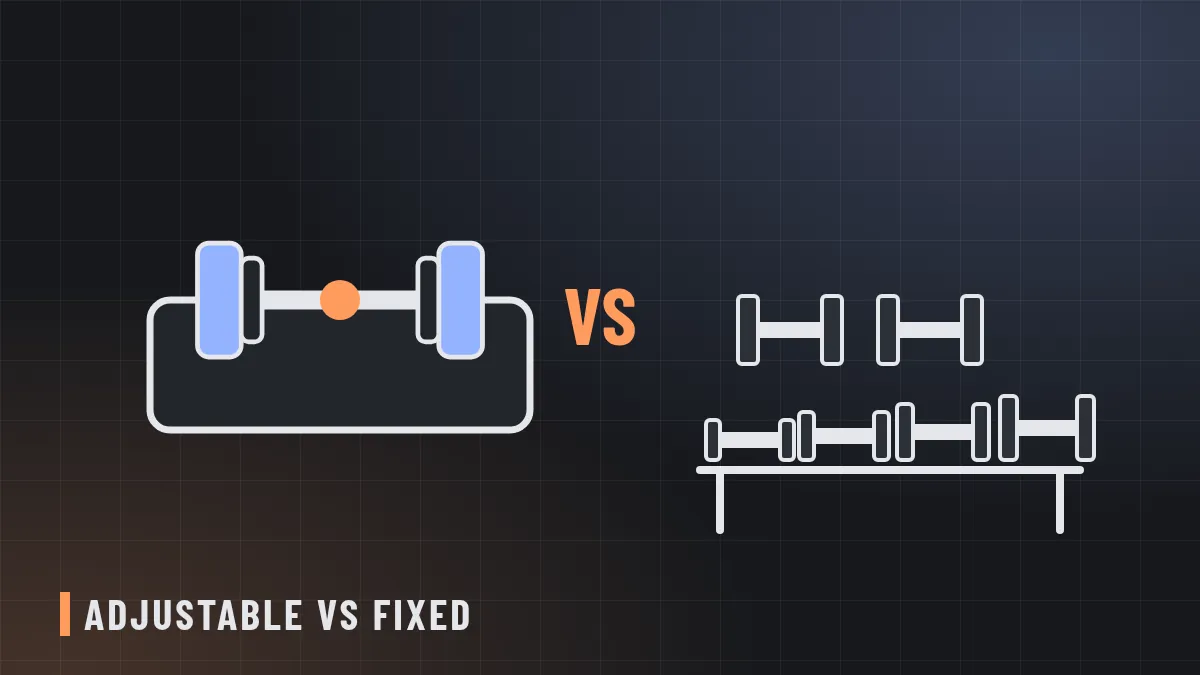
For a first home gym in a small space, adjustable dumbbells usually win: one pair covers a wide range of weights in the footprint of a single pair. Fixed dumbbells win on durability, speed and simplicity, but a full set takes a lot of floor space and money.
This comparison is research-based, drawing on manufacturer specifications and manuals, not hands-on testing of specific models. Prices are rough ranges for new gear in the U.S.; check current prices.
The short version
| Feature | Adjustable dumbbells | Fixed dumbbells |
|---|---|---|
| Floor space | One pair, often in a tray or stand | A rack for the set, often several feet of wall |
| Weight range | One pair often covers 5 to 50 lb (2 to 23 kg) per hand; some go higher | Whatever pairs you buy |
| Cost | Roughly $120–$500 for a pair going up to about 50 lb (spin-lock sets at the low end, quick-change dial types higher) | Often roughly $1.50–$3 per pound new, so a full set adds up |
| Changing weight | A few seconds (dial or pin) to a minute (spin-lock collars) | Instant: grab the next pair |
| Durability | More moving parts; some types must not be dropped | Very durable, especially rubber hex |
| Feel | Some types stay full length even at light weights | Compact at light weights |
Why adjustables suit small spaces
The numbers make the case. A set of fixed dumbbells from 5 to 50 lb in 5 lb steps is 10 pairs. That's 550 lb of iron (5 + 10 + … + 50 = 275 lb, times two). At roughly $1.50–$3 per pound new, that's somewhere around $800–$1,650, plus a rack to hold it all against a wall.
An adjustable pair covering a similar range typically costs a fraction of that and sits in a footprint of about one pair. For a corner or spare-room gym, that's the deciding factor. Our Home Gym Planner puts adjustable dumbbells near the top of the list for that reason.
The three main types of adjustable dumbbell
Dial or selector
You set the weight with a dial or switch while the dumbbell sits in its tray, and it picks up only the plates you selected.
- Pros: fast changes; tidy.
- Cons: usually the same length at every weight, which can feel bulky for light exercises; more moving parts; many manufacturers say not to drop them. Check the manual.
Pin-select or locking-handle
You slide a pin or turn a handle to lock in a weight while it sits in the tray.
- Pros: quick changes; often sturdier designs.
- Cons: usually more expensive; still bulkier than fixed dumbbells at light weights.
Spin-lock (plate-loaded)
A threaded handle, small plates and screw-on collars, the old-school way.
- Pros: cheapest; simple; easy to add more plates later.
- Cons: slow to change; collars can loosen during a set, so check them before every set; plates can rattle.
When fixed dumbbells make more sense
- You have a garage or a dedicated room with wall space for a rack.
- You'll share the gym with someone who uses different weights at the same time.
- You like supersets or circuits where you switch weights quickly.
- You want gear that can take hard use for years, or you can find a good deal on a used set.
A hybrid works well too: an adjustable pair for most work, plus one or two fixed pairs at weights you use all the time.
What to look for when buying
- Weight range and steps. A maximum of about 50 lb (23 kg) per hand covers most beginners for a long time. Smaller steps (2.5 to 5 lb) make progress easier on presses and raises.
- Length at the heaviest setting. Longer dumbbells can bump your shoulders or legs on some exercises.
- How the weight changes, and whether that's something you'll put up with mid-workout.
- Drop rules and warranty. Read the manual's rules on dropping and the warranty terms before you buy.
- Room to grow. Some systems sell add-on plates or expansion kits.
Are adjustable dumbbells worth it for a small home gym?
For most people, yes. One pair covers a wide range of weights in the floor space of a single pair, and it usually costs far less than a full fixed set.
What weight range do beginners need?
Many beginners do well with dumbbells that go from about 5 to 50 lb (2 to 23 kg) per hand. Stronger lifters, or those planning heavy lower-body work, may want a higher maximum.
Can you drop adjustable dumbbells?
It depends on the design. Many dial-style dumbbells are not meant to be dropped. Check the manufacturer's manual and warranty, and set them down gently, especially on an upper floor.
Building the rest of your setup? See how to start a home gym on a budget and our flooring and noise guide.