Power Rack vs Half Rack vs Squat Stands (and Folding Racks) for Small Spaces
How power racks, half racks, squat stands and folding wall-mounted racks compare on footprint, height, safety, stability and cost, and which one suits a small home gym.
Disclosure: Product links on this site aren't affiliate links: we don't earn anything from them today. If that changes, we may earn a commission at no extra cost to you, and this note will say so. Parts of this article were drafted with AI assistance and edited before publishing. Read our disclaimer.
A power rack is the safest and most versatile way to hold a barbell, but it's also the biggest. Squat stands take the least floor and money, a half rack sits in between, and a folding wall-mounted rack gives you most of a rack that disappears when you're done, if you can bolt it to the wall.
This comparison is research-based, drawing on manufacturer specifications and manuals rather than hands-on testing of specific models. Sizes and prices vary a lot by model; treat the numbers below as rough ranges and check the listing and the current price.
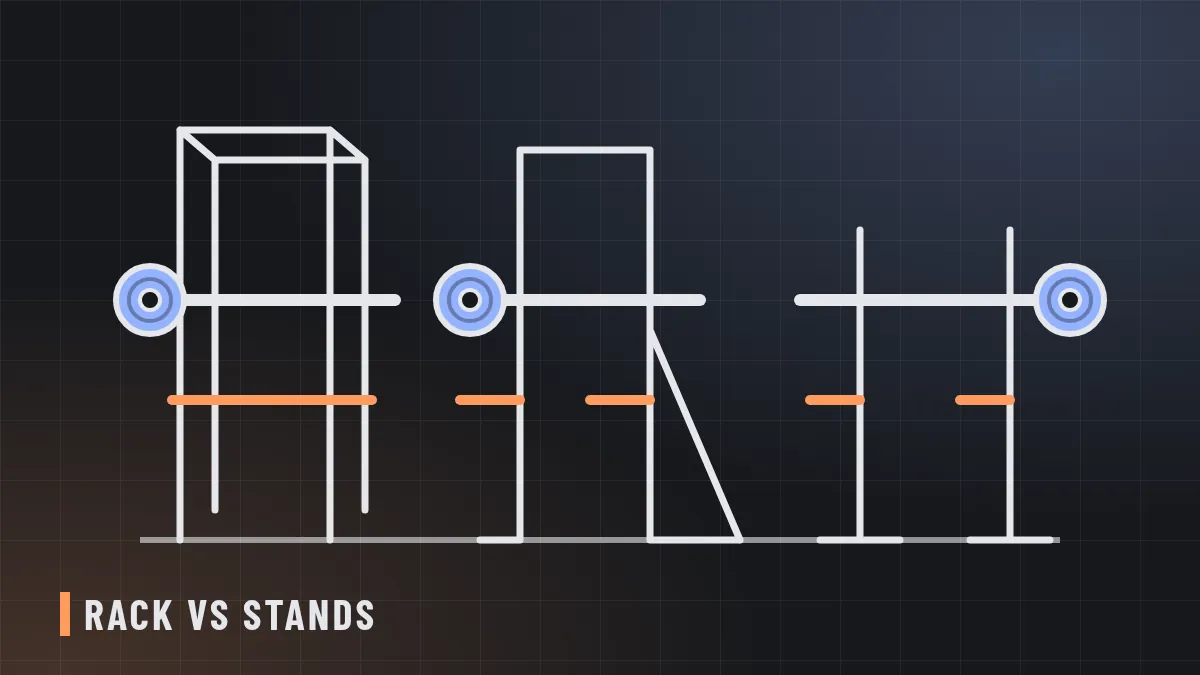
What each one is
- Power rack (full rack or cage): four upright posts joined into a box. You lift inside it, with safety pins, pipes or straps on both sides. Many have a pull-up bar on top.
- Half rack: two main uprights at the front, braced to a base or a shorter pair of posts behind. You lift in front of it, with spotter arms reaching forward.
- Squat stands: two uprights that hold J-hooks. Some are two separate stands; others share a base. Safeties come as spotter arms, or as straps or bars that run between a pair of stands.
- Folding wall-mounted rack: a rack bolted to the wall that swings or folds flat against it between sessions.
The comparison
| Feature | Power rack | Half rack | Squat stands | Folding wall rack |
|---|---|---|---|---|
| Typical footprint | Often roughly 4 × 4 to 4 × 5 ft | Varies; often smaller in depth | Small; independent stands take a few square feet each, while stands joined by a base are often about 4 × 4 ft | Often about 5–6 in from the wall when folded (deeper versions can take more) |
| Safeties | Pins, pipes or straps on both sides; you're inside the box | Spotter arms in front | Spotter arms or straps; check what's included | Usually spotter arms or pins |
| Stability | Very stable; many can be bolted down | Stable with a good base or weight storage | Least stable; light stands can shift if bumped | Stable once properly mounted |
| Typical new price | Roughly $350–$1,000 | Roughly $300–$900 | Roughly $150–$450 | Roughly $300–$800 |
| Install | Freestanding or bolted | Freestanding | Freestanding | Bolted into wall studs (often floor too) |
| Renter-friendly? | Yes | Yes | Yes | Usually not |
Footprint: the small-space question
The rack itself is only part of the space. A 7.2 ft Olympic bar sticks out past any rack, and you need room past each end to slide plates on and off, so plan on roughly 9 ft wall to wall at the very least and 10 ft or more to be comfortable. You also need room in front to walk a squat out and to slide a bench in. Our space guide covers the layout, and the Home Gym Planner checks your floor for a barbell zone.
What a smaller rack saves is mostly depth and visual bulk. Squat stands and folding racks can share a room with a desk or a car in a way a full cage can't.
Height: check your ceiling first
Full-height power racks are commonly listed at roughly 80 to 93 in tall, and several makers sell shorter versions in the low 70s for basements and low garages. Half racks and squat stands are often shorter, and many stands adjust in height. If you want to do pull-ups on top of a rack, you'll need about a foot of headroom above the bar. Remember the rack also has to be tipped upright during assembly, which can take more room than its standing height; check the manual. The ceiling height guide has the full formula.
Safety: what actually matters
All four designs can be safe if you use the safeties. What matters most:
- Safeties that suit how you'll train. If you'll squat or bench alone, you need pins, pipes, straps or spotter arms set just below the bottom of each lift. Check they're included or budget for them.
- A listed weight rating for the uprights, J-hooks and safeties that's well above what you'll lift. Racks and stands of the same price can be rated very differently.
- Stability. Separate squat stands are the easiest to knock out of line; put the same hole number on both sides and re-check before each session. Loading weight-storage horns on a half rack or the back of a rack adds stability.
- Hole spacing. Closer hole spacing in the bench and squat zone lets you set the J-hooks and safeties at the right height for your body.
More in our home gym safety checklist.
Folding racks: the catch
Folding racks are a clever answer for a garage that still has to fit a car, or a spare room that has to double as an office. But they usually need to be bolted into wall studs and sometimes the floor, following the manual exactly. That's often a no for renters, and it's worth confirming your wall can take it: stud spacing, wall material and what's behind the drywall all matter. Many folding racks also have a fixed width set by the studs, and you still need the bar's full width to train.
Which should you choose?
- Choose a power rack if you have the room (including the ceiling), want the most protection when lifting alone, and might add attachments later.
- Choose a half rack if a full cage is too deep for the room but you still want a stable base, weight storage and spotter arms.
- Choose squat stands if the room is tight, the budget is small or the space has to be shared. Pick a model with proper safeties.
- Choose a folding rack if you own the home, can mount it properly, and need the floor back between sessions.
Not sure you want a barbell at all? Many beginners do very well with dumbbells and a bench first. When you do start barbell training, our plate calculator handles the loading math.
Are squat stands as safe as a power rack?
Squat stands can be safe for home training if they have spotter arms or straps and you set them just below the bottom of each lift. A power rack is more stable and puts safeties on both sides of you, which is why many people who lift alone prefer one.
Will a power rack fit under an 8 ft ceiling?
Many will. Full-height racks are commonly listed at about 80 to 93 in tall, and an 8 ft ceiling is 96 in. Pull-ups on top of the rack usually need around a foot above the bar, so a shorter rack may be the better choice. Check the listing and measure your lowest ceiling point.
Can I install a folding rack in a rented home?
Usually not without the landlord's permission, because folding racks are normally bolted into the wall studs and sometimes the floor. Freestanding squat stands or a half rack are the renter-friendly options.