A Simple Full-Body Dumbbell Routine for Your First Home Gym
A beginner full-body dumbbell workout you can do two or three times a week in a small space, with exercises, sets and reps, how to progress and how it lines up with the U.S. Physical Activity Guidelines.
Disclosure: Product links on this site aren't affiliate links: we don't earn anything from them today. If that changes, we may earn a commission at no extra cost to you, and this note will say so. Parts of this article were drafted with AI assistance and edited before publishing. Read our disclaimer.
A pair of dumbbells and a bench are enough for a complete beginner routine. Do six movements (squat, hinge, push, pull, single-leg and carry) two or three times a week, stop each set with a couple of reps left in the tank, and add a little weight or a rep when it gets easy.
This is general information for healthy adults, not a personal program or medical advice. Before starting a new exercise program, especially if you have a health condition, an injury, are pregnant or haven't exercised in a while, check with a doctor. Stop if you feel pain, dizziness or chest discomfort. See our disclaimer.
How much strength training is enough?
The U.S. Department of Health and Human Services' Physical Activity Guidelines for Americans (2nd edition, 2018) recommend that adults do muscle-strengthening activity of moderate or greater intensity that works all major muscle groups on 2 or more days a week, alongside 150 to 300 minutes a week of moderate-intensity aerobic activity (or 75 to 150 minutes of vigorous activity). The Guidelines list the major muscle groups as the legs, hips, back, abdomen, chest, shoulders and arms.
On sets and reps, the first edition of the Guidelines (2008) put it simply: one set of 8 to 12 repetitions of each exercise is effective, although two or three sets may be more effective. The routine below is built around that.
What you need
- Adjustable dumbbells or a few pairs of fixed ones. See adjustable vs fixed dumbbells.
- A bench, flat or adjustable (a sturdy step or box can stand in for some moves). See flat vs adjustable benches.
- About 6 × 8 ft of floor with rubber flooring. Our Home Gym Planner checks whether a dumbbell-and-bench station fits your room.
The routine
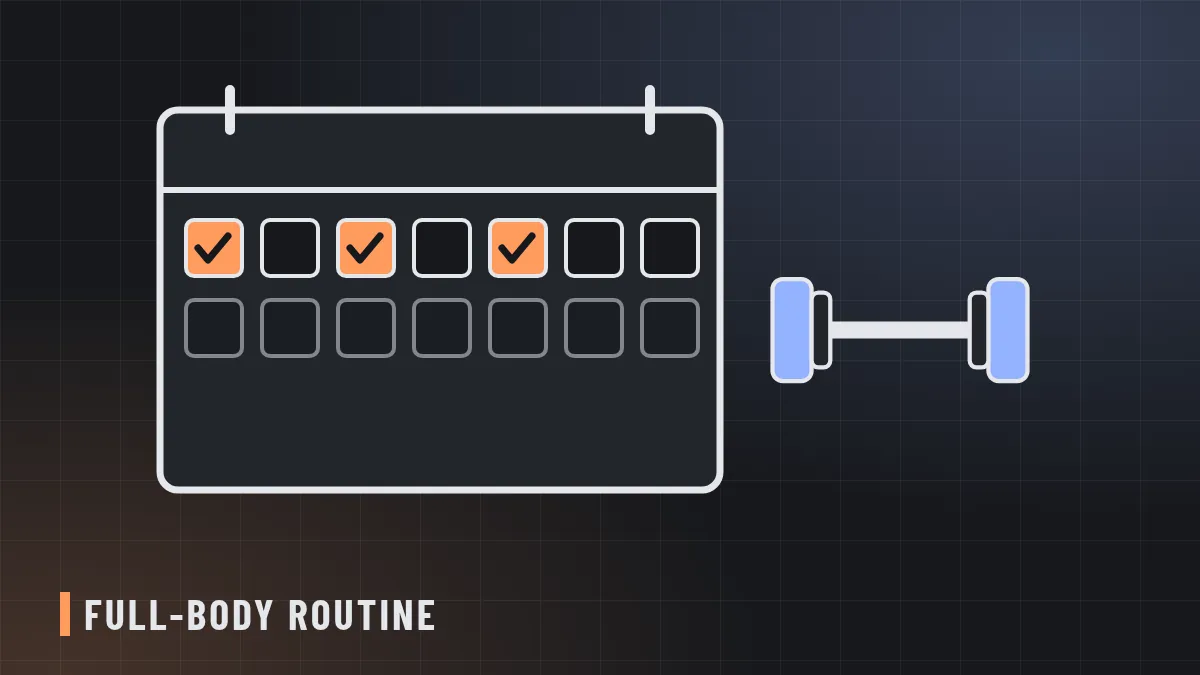
Do it on two or three non-consecutive days a week, such as Monday, Wednesday and Friday.
| # | Exercise | Sets × reps | Works |
|---|---|---|---|
| 1 | Goblet squat | 2–3 × 8–12 | Legs, hips |
| 2 | Dumbbell Romanian deadlift | 2–3 × 8–12 | Hips, hamstrings, back |
| 3 | Dumbbell bench press (flat or incline) | 2–3 × 8–12 | Chest, shoulders, arms |
| 4 | One-arm dumbbell row | 2–3 × 8–12 each side | Back, arms |
| 5 | Split squat or step-up | 2 × 8–12 each leg | Legs, hips, balance |
| 6 | Seated dumbbell shoulder press | 2 × 8–12 | Shoulders, arms |
| 7 | Farmer's carry, then a plank | 2 × about 30–40 steps; 2 × 20–30 seconds | Grip, core, abdomen |
Rest about 1 to 2 minutes between sets. A session usually takes 35 to 50 minutes. In your first week or two, one set of each is plenty while you learn the movements.
How to do each exercise (the short version)
- Goblet squat. Hold one dumbbell vertically at your chest. Feet about shoulder-width, sit down between your hips as far as is comfortable with a neutral back, then stand up.
- Romanian deadlift. Hold a dumbbell in each hand in front of your thighs. With a slight knee bend, push your hips back and lower the weights along your legs until you feel a stretch in your hamstrings, keeping your back flat. Stand back up by driving your hips forward.
- Dumbbell bench press. Lie on the bench, feet flat. Press the dumbbells up over your chest, then lower them under control to the sides of your chest.
- One-arm row. One hand and knee on the bench, back flat. Pull the dumbbell toward your hip, then lower it slowly.
- Split squat or step-up. For a split squat, stand in a long stride and lower your back knee toward the floor. For a step-up, step onto a sturdy bench or box with your whole foot and stand tall. Hold dumbbells once you're steady.
- Seated shoulder press. Sit upright with back support if you have it. Press the dumbbells overhead and lower them to shoulder height. Seated pressing also saves headroom; see our ceiling height guide.
- Farmer's carry and plank. Walk tall holding heavy dumbbells at your sides. Then hold a plank on your forearms with a straight line from shoulders to heels.
If a movement hurts, skip it and ask a qualified coach or physical therapist for an alternative.
How heavy, and how to progress
- Pick a weight you can lift for the top of the rep range with good form, finishing each set with about 2 reps left. The 2008 Guidelines describe training to the point where another rep would be difficult without help. Beginners can stop a little short of that while learning.
- Use "double progression." Stay at a weight until you can do the top of the range (say 12 reps) on every set with good form, then go up to the next weight and work back up from 8.
- Keep a simple log. Write down the weight and reps for each exercise. It's the easiest way to see progress.
- Small jumps matter. Adjustable dumbbells with 2.5 to 5 lb steps make presses and rows much easier to progress.
Fitting in the rest of the Guidelines
Strength sessions cover the muscle-strengthening part. For aerobic activity, brisk walks, cycling or short kettlebell or jump-rope sessions (if you have the headroom) on other days add up toward the 150-minute weekly target. The Guidelines also say to move more and sit less throughout the day, and that some activity is better than none.
Making it work in a small space
- Train on rubber and set dumbbells down under control, which matters in apartments; see our flooring and noise guide.
- No bench yet? Do floor presses lying on your mat, and rows with one hand on a sturdy chair.
- Short on time? Pair exercises (squat with row, Romanian deadlift with press) and alternate between them.
How many days a week should a beginner lift weights at home?
Two or three non-consecutive days a week works well. The U.S. Physical Activity Guidelines recommend muscle-strengthening activity for all major muscle groups on 2 or more days a week.
Can you build muscle with just dumbbells?
Yes. Dumbbells can train every major muscle group, and adding weight or reps over time is what drives progress. Adjustable dumbbells make that easy in a small space.
How many sets and reps should a beginner do?
A common starting point is 1 to 3 sets of 8 to 12 reps per exercise. The 2008 Physical Activity Guidelines note that one set of 8 to 12 reps is effective and two or three sets may be more effective.
Need the gear first? Start with what to buy first for a home gym.